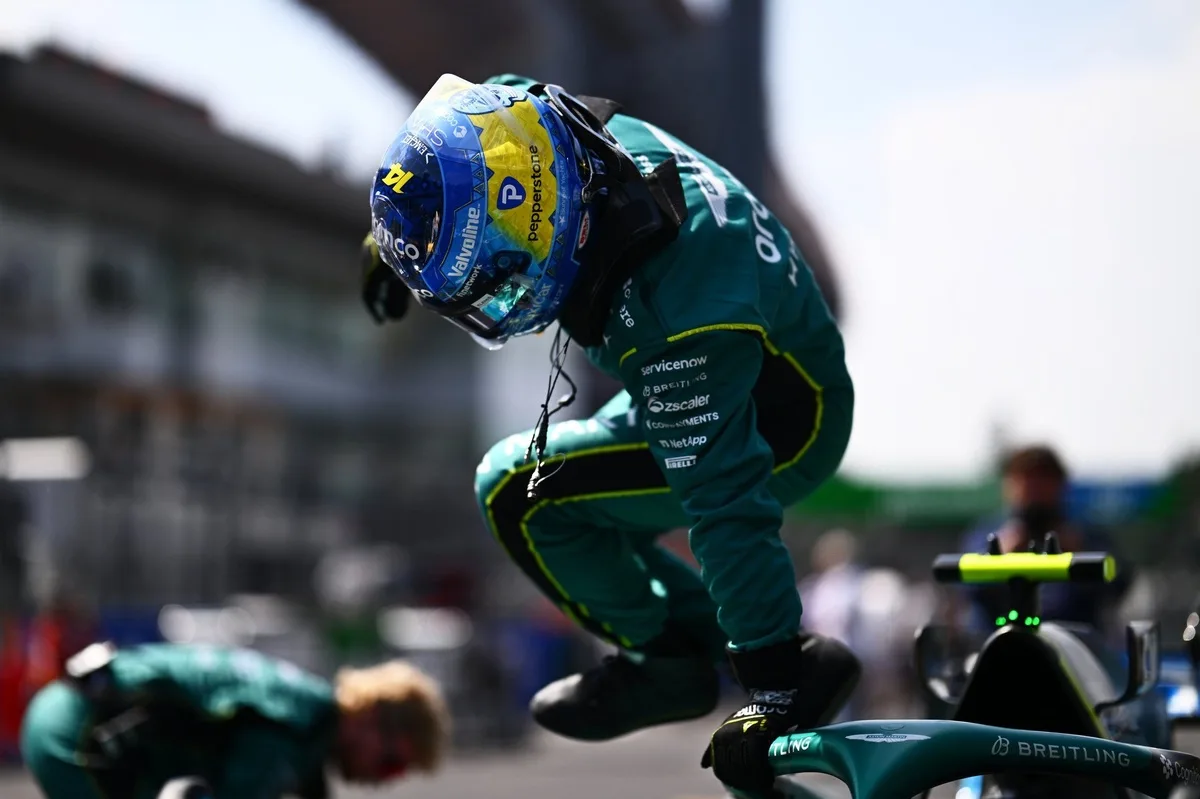
MEXICO CITY — Aston Martin’s Mexico Grand Prix unravelled after barely five laps as Fernando Alonso and Lance Stroll were both forced to retire with cooling issues on their Honda power units at the Autodromo Hermanos Rodriguez. The double failure wasted a promising start to the weekend in which Alonso finished just 0.769s behind pacesetter Charles Leclerc in FP2, with the two AMR26s completing 144 laps across all three practice sessions.
Honda’s trackside general manager and chief engineer Shintaro Orihara said the high-altitude conditions placed greater strain than expected on the system. “We knew that with the special high-altitude circumstance of Mexico City, we would face some additional challenges compared to other racetracks for the cooling,” Orihara said. “However, we found that our ERS cooling circuit was under heavier stress than anticipated and this is why we had to stop the car in different sessions.”
Honda had fixed driveability and turbo lag issues between FP3 and qualifying, but Alonso reported “abnormal signals on the water systems” on Saturday afternoon. He still outqualified Stroll, yet both cars were eliminated in Q1, four tenths short of the Q2 cut-off. Orihara explained that without the MGU-H to support the turbo on the new, simpler power units, lag was a particular problem in the thin Mexico City air. “The car is very good,” Alonso said. “The problem is just, we cannot do more laps than a certain number, apparently, with the engine. Hopefully we learned a lesson and we come next year more prepared.”
Aston Martin chief trackside officer Mike Krack said the Adrian Newey-designed machine had shown genuine potential for the low-speed sections. “On Thursday, when we sat together, we said this is a track that has a lot of low-speed corners,” Krack said. “And if we get the driveability under control, that we can be competitive. For example, corners like the stadium section, [Turns] 4-5-6, low-speed stuff.” That pace was hinted at on Sunday, when Alonso’s best three sectors combined, despite pitting on lap three with a full tank of fuel, were nearly as quick as Williams’ Carlos Sainz.
Reliability remains the central concern. “It's difficult for everyone to keep the motivation high in such situations, and we are struggling all year already,” Krack admitted. “We had a very difficult start of the year, then the period when we introduced the upgrades and the ADUO, we [had] a bit better results. Now, we have more trouble in terms of reliability.” Alonso suffered his seventh retirement of the season but insisted: “I’m doing my best every time, every lap I do, every morning I wake up, every preparation I do, every food I take – everything is focused on performing at my best behind the wheel.” Orihara added: “At each race this year, we need to learn for 2027, even the hard lessons.”